
How Town keeps AI assistants running with Firetiger
George Kontridze, founding engineer at Town, works across infrastructure and developer productivity. I sat down with him to talk about what changed when his team plugged Firetiger into their deploy pipeline.

Town is an AI assistant that connects to the systems people already use every day; email, chat, WhatsApp, productivity tools, it's your personal assistant for all you day-to-day work.
Tests pass, issues only manifest in production
Over the last 15 years, I've experienced first-hand how much time we spend as engineers dealing with the complexity of making sense of whatever is going on in production.
We try our best to apply robust validation strategies at every step of the SDLC, but somehow defects still reach production and cause outages that impact customers.
We implement observability strategies to help us mitigate those inevitable incidents, but those quickly turn into their own problem space, releasing storms of information that often don't tell us much about what is actually going on.
So the story that George told meant a lot to me.
"There's so much noise coming from Sentry we don't really pay attention to specific events. When a Firetiger notification comes in, we're much more likely to pay attention to it because it's been curated. We know this is something we should be looking into."
When I heard this, I felt a mix of compassion and delight.
Compassion because I know what he's been through, how much it takes to maintain a high development velocity while ensuring the product runs reliably.
And I was delighted to hear that Firetiger had offered a meaningfully different experience, one that he could trust.
Agents watch all your deploys
Town connected Firetiger to their telemetry stack: Axiom for logs, plus Vercel and Convex on the deployment side. Then they turned on Change Monitors, and on each pull request they opened, a Firetiger agents joins and helps them plan and watch the deploy.
The agent reads the diff, assesses risk, and establishes a monitoring window after deploy to verify two properties:
1) that the intended effect of the change is observed
2) that no regressions are introduced by the change
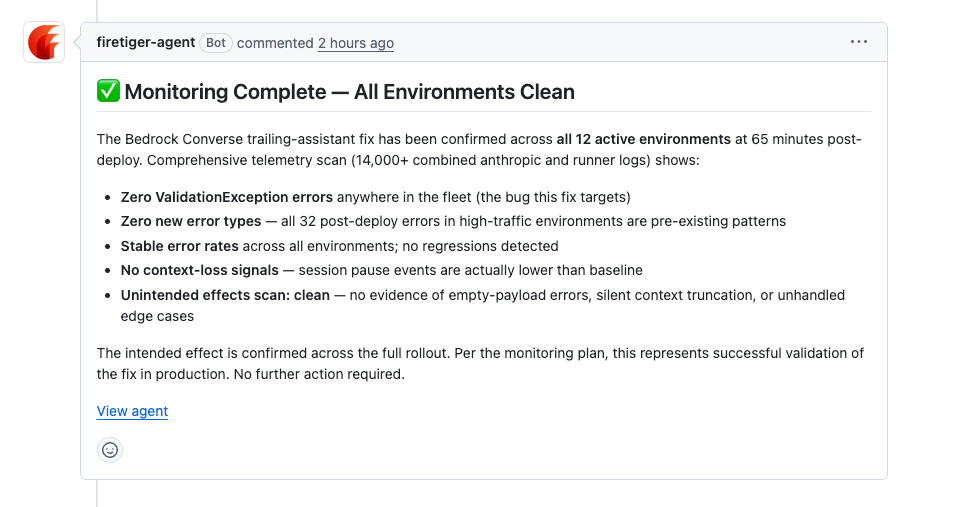
Setup was a one-time effort, and now the entire engineering team has benefited from it.
Agents catch and resolve issues in minutes
Despite all the intelligence we throw at vetting that a change behaves as intended, issues inevitably end up discovered after the code was deployed.
Change monitor agents do catch regressions, but they go beyond to assist engineers in resolving issues. George's experience on the problem here is one that most of us have gone through, and really resonates:
"Sometimes debugging can go on for hours or days. Firetiger is very much: here's where the problem is, here's what we need to do, fix it."
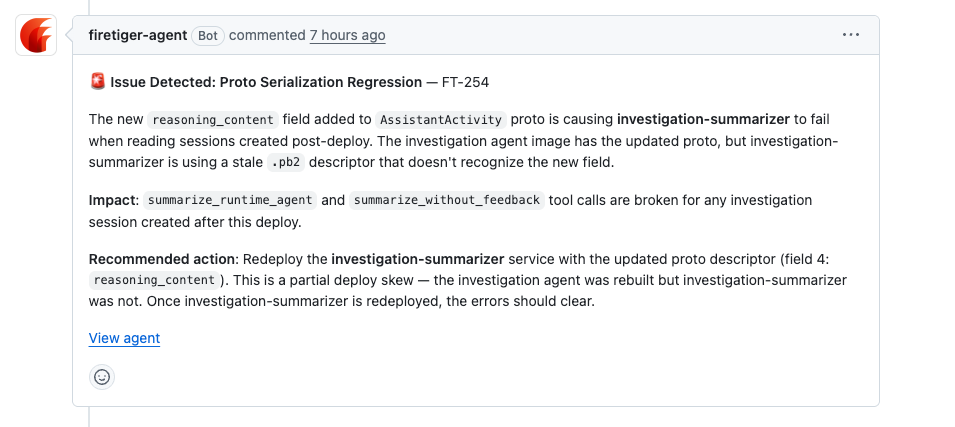
Not only agents alert when a deployment has an issue, but they also do root cause analysis (RCA), issue triage, and plan fixes that can be handed off directly to a coding agent!
Where we're heading
As more and more of the SDLC is being automated by AI agents, we're clearly seeing a shift in our role and responsibilities of software engineers.
George put in words better than I could:
"As we lift ourselves out of the mechanical layer of writing code and into thinking about behavior, our job is to let the agents do their best work by giving them the best context possible, and keeping the iteration loop as tight and as short as possible.
My job is to be the steward of the context."
That's the loop Firetiger is designed to close. Coding agents write the code; Firetiger makes sure it works in production, curating the context that will be sent back to fix when issues inevitably make it to production.